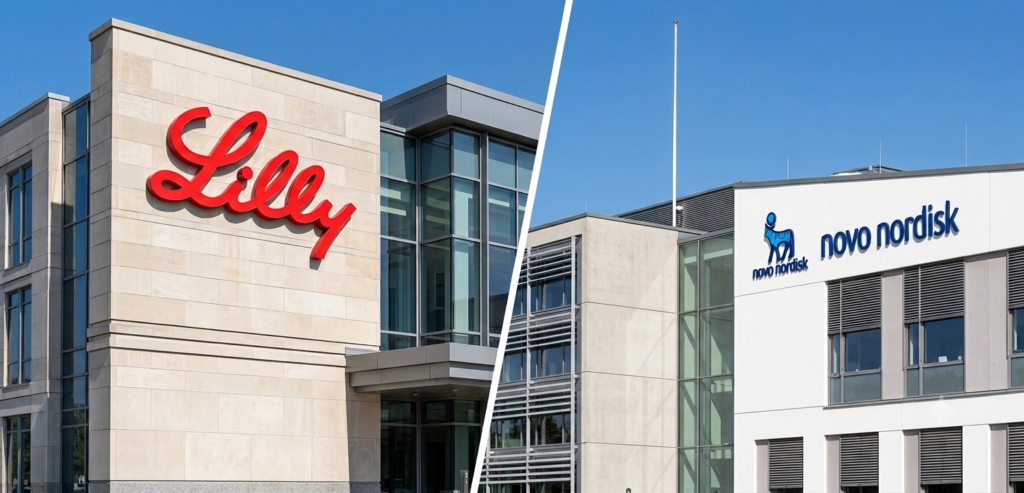
The GLP-1 rivalry between Novo Nordisk and Eli Lilly has moved from earnings calls and market share charts into a New Jersey courtroom.
Novo Nordisk filed a motion for a preliminary injunction on July 24, escalating a lawsuit it brought against Eli Lilly on July 21 over what it calls misleading comparative advertising for Lilly’s GLP-1 franchise. The injunction motion asks the court to immediately halt Lilly’s national ad campaigns for Mounjaro and Zepbound while the underlying case proceeds, rather than waiting for a final ruling that could take months.
The specific claim at the center of the case
Novo’s complaint centers on a dosing comparison it says is deliberately misleading. According to Novo, Lilly’s advertising compares Mounjaro at its highest approved dose, 15 mg, against a lower 1 mg dose of Novo’s Ozempic, without disclosing that the FDA approved a higher, more effective 2 mg maintenance dose of Ozempic more than four years ago. Novo argues that comparing Lilly’s top dose against anything other than Novo’s top dose creates a false impression of Mounjaro’s relative effectiveness, and that the omission of the approved higher dose is the deceptive element the court should address.
Novo is asking for a permanent injunction requiring Lilly to pull the campaigns in question, along with a court-mandated corrective advertising campaign, a remedy that goes beyond simply stopping future ads and would require Lilly to actively correct the public record.
Lilly pushes back
Eli Lilly has rejected the characterization outright. In a statement responding to the injunction filing, the company said its advertising is truthful, transparent, and grounded in the most direct scientific evidence available, signaling it intends to contest the motion rather than adjust its campaigns preemptively.
The dispute follows an earlier flashpoint this month when the FDA itself flagged one of Novo’s own television ads for its oral obesity pill as false or misleading, a reminder that regulatory scrutiny of comparative and promotional claims is intensifying across the GLP-1 category generally, not just in the Novo-Lilly dispute.
Why the stakes are so high
The legal fight is playing out against a backdrop of enormous and growing commercial stakes. Lilly’s Zepbound generated roughly $4 billion in sales in the first quarter of 2026 alone, compared with 18.2 billion Danish kroner, or roughly $2.7 billion, for Novo’s Wegovy over a comparable period. With both companies racing to defend and expand market share in the largest pharmaceutical category to emerge in a generation, advertising claims that shift prescriber or patient perception by even a few percentage points translate into hundreds of millions of dollars in quarterly revenue.
That commercial intensity helps explain why Novo chose to seek emergency injunctive relief rather than let the dispute play out on a normal litigation timeline. A campaign running unchallenged for the months or years a full trial might take could meaningfully entrench prescriber habits and patient perceptions in Lilly’s favor, injunction or no injunction down the line.
A test case for GLP-1 marketing broadly
Beyond the two companies involved, the case is being watched as a potential test of how aggressively GLP-1 manufacturers can lean on head-to-head dosing comparisons in a category where dosing schedules, titration protocols, and approved maintenance doses differ enough between competing products that comparative claims are genuinely difficult for consumers, and sometimes physicians, to parse without careful context.
A ruling that requires clearer, apples-to-apples dosing disclosures in comparative pharmaceutical advertising would have implications well beyond Novo and Lilly, given how central head-to-head positioning has become to marketing strategy across the broader obesity and diabetes drug category as more entrants reach the market over the next two years.
No hearing date for the injunction motion had been set as of this writing.